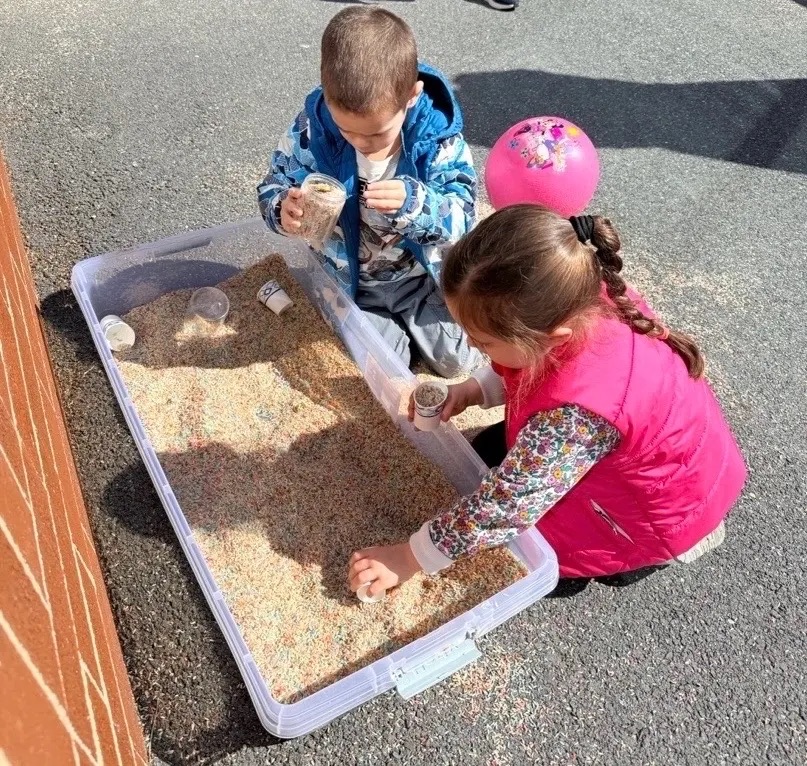
Here’s something most parents don’t realize: The moments that teach kids how to be a good friend rarely happen in the classroom. They happen on a playground, at a snack table, or mid-game, when someone doesn’t get their turn. Many parents assume social skills are built through structured lessons or direct coaching. While those things certainly help, the real magic happens through play with peers. The benefits of summer camp go far beyond swimming and s’mores.
For young children, a thoughtfully designed camp environment can become one of the most powerful social learning experiences of their early years. At Basal Therapies & Preschool, we’ve watched this unfold summer after summer, and we want parents to understand exactly how and why it works.
Why Play Is How Kids Learn to Connect
Child development research has long recognized play as the primary context in which young children build social and emotional competence. According to the American Academy of Pediatrics, play is so essential to healthy development it’s been recognized by the United Nations High Commission for Human Rights as a right of every child.
Through unstructured and semi-structured play, children naturally practice:
- Turn-taking: Waiting, sharing, and giving space to others
- Reading social cues: Noticing when a friend is frustrated, excited, or needs a break
- Managing conflict: Working through disagreements without adult intervention (or with just a little help)
- Regulating emotions: Handling the big feelings that come with winning, losing, or being left out
And here’s what’s important for parents to hear: Struggling in these areas is not a red flag. It’s a part of learning. Every child, regardless of ability or background, is still working on this skillset. With the right environment around them, the child who has a hard time joining a group game today can be the one leading it by the end of the summer.
What Social Skills Actually Get Practiced at Camp
It’s one thing to say “camp builds social skills.” It’s another to show you the precise mechanisms. Here’s a look at how the daily rhythm of summer camp activities for 3–5 year olds fits directly onto real social skill development:
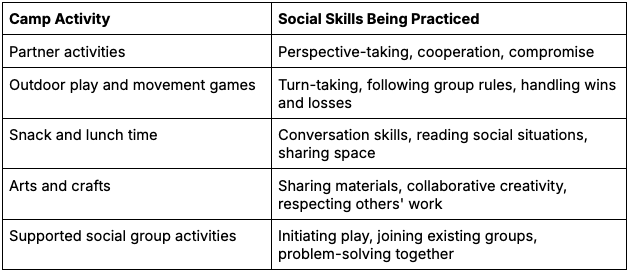
When your child sits across from a friend at snack time and has to ask to borrow the crackers, or when they have to wait for their turn at the ball wall, or when they disagree with a partner about which bug to draw, that’s real-world social skills practice in action. Camp is not preparation for life; it is life, in a supported form.
Why the Camp Environment Matters as Much as the Activities
The benefits of summer camp are most fully realized when the environment itself is thoughtfully designed to support each child. Here’s what makes the difference:
Small group sizes mean more reps. Social learning requires repetition. When group sizes stay small, kids get more opportunities to interact, more chances to try again after a misstep, and more feedback from peers and adults.
Consistent peers build real friendships. Seeing the same group of kids week after week, or across multiple weeks for returning campers, allows relationships to deepen beyond parallel play. Real friendships start to form, and with them real social confidence.
A truly inclusive environment creates richer practice. When children of varying abilities share the same space, they encounter the full range of human differences early. That exposure doesn’t just build empathy; it creates more realistic social practice than a homogeneous peer group ever could. Every child is welcome here, and that’s not just a policy. It’s a philosophy that shapes everything we do.
Licensed therapists on staff means no teachable moment is wasted. When a social challenge arises (a conflict, meltdown, or moment of exclusion) our team is trained to recognize it as an opportunity, not just a disruption. Our licensed therapists are woven into the daily flow of camp, which means support is embedded directly into the experience.
Signs Your Child Could Benefit From a Socially Supportive Camp
You know your child best, but sometimes it helps to have a framework for what to look for. The following are gentle indicators, not a diagnostic checklist, that a child might especially thrive in a camp environment designed with social growth in mind:
- Has a hard time joining group play, even when they want to
- Tends to play alongside rather than with peers (parallel play that hasn’t yet moved toward cooperative play)
- Gets frustrated or shuts down during games with rules
- Struggles with transitions in group settings
- Has difficulty initiating conversation with unfamiliar children
If any of these sound familiar, please know they’re both common and workable. The right environment can make a profound difference. It’s something we see every single summer.
What Makes Basal’s Summer Camp Different
When you’re searching for summer camps in Frederick, MD, you’ll find options ranging from sports-focused programs to arts camps to general day-camp experiences. But Basal’s Summer Camp is something distinct, and it’s worth understanding why.
Our camp leaders aren’t just supervisors; they’re facilitators. The licensed therapists and trained professionals on our staff aren’t watching from the sidelines. They’re intentionally woven into summer camp activities for 3–5 year olds (and older campers, too) and use their clinical expertise to turn ordinary camp moments into meaningful developmental experiences.
We include both structured and leisure activities, by design. Kids need both to generalize social skills. A child who can take turns during a guided partner activity also needs to practice that skill in a more open-ended, less structured setting, like outdoor free play. We build both into every camp day, which means the seedling skills have more places to take root.
Engaging themes keep excitement high and that matters for social interaction. Each week of camp centers around a new theme, from A Bug’s Life to Space Adventures to Carnival, because shared enthusiasm is a powerful social catalyst. When every child in the room is equally curious about the same thing, connections form more naturally.
Before and aftercare extends the social day. For families who need early drop-off or late pickup, those extended hours give children who need more time and repetition extra practice in low-stakes, relaxed settings. That kind of unhurried time with peers is its own kind of gift.
And perhaps most importantly: Summer camps in Frederick, MD don’t always offer the combination of clinical expertise and genuine joy that you’ll find at Basal. We believe those two things belong together. Therapy and fun aren’t opposites; they’re partners.
A Word on Research
The evidence supporting the benefits of summer camp for young children continues to grow. Studies consistently show that high-quality early childhood programs improve social competence, emotional regulation, and school readiness. Research from the American Camp Association has found that the vast majority of parents report that camp helps their children make friends, develop independence, and build confidence: all of which feed directly into the social skill foundation that sets children up for kindergarten and beyond.
For children who receive therapeutic services, the overlap between camp and clinical goals creates a natural opportunity for generalization: taking skills learned in therapy and practicing them in real-world, peer-rich environments. That’s not a coincidence at Basal; it’s the whole point.
Come Play With Us This Summer
Summer camp done right is one of the most meaningful investments you can make in your child’s social confidence. It improves their ability to walk into a room and feel like they belong, know they can make a friend, and can work through a hard moment and come out the other side. In short, the benefits of summer camp are extensive. The cherry on top is that these benefits come while the kids are having fun!
At Basal Therapies & Preschool, we love these kids. We love watching them grow. And we’d love for your child to be part of our summer. Ready to give your child a summer full of play, connection, and growth? Learn more about Basal’s 2026 Summer Camps and register today.
Get in touch!
If you think your child could benefit from our support and services, send us a message!